- Sun Salutation
- Headstand
- Inverted Triangle Pose
- Hand to Foot Pose
- Lion Pose
- Head to One Knee Pose
- Head to Knees Pose
- Camel Pose
- Sage Marichi Twist Pose
- Half Lord of the Fish Pose
- Inverted Leg Stretch Pose
- Shoulder Stand
- Plough Pose
- Inclined Plane
- Boat Pose
- Fish Pose
- Wheel Pose
- Bridge Pose
- Downward Facing Dog Pose
- Cobra Pose
- Bow Pose
- Locust Pose
- Eagle Pose
- Crow Pose
- Corpse Pose
- Yoga Balance Asanas
- Yoga Asanas For Spine
- Yoga Asanas in Chair
- Basic Yoga Asanas For Stomach
- Yoga Asanas For The Neck
- Yoga Asanas For Depressed
- Yoga Asanas For Beginners
- Sequencing Yoga Asanas
- One Legged King Pigeon Pose - Eka Pada Rajakapotasana
- Reclining Bound Angle Pose - Supta Baddha Konasana
- Eight Angle Pose - Astavakrasana
- Hand Clenching
- Side Crane Pose - Parsva Bakasana
- Ankle Rotation
- Circle pose - Mandalasana
- Dolphin Plank Pose
- Half Frog Pose - Ardha Bhekasana
- Four-Limbed Staff Pose - Chaturanga Dandasana
- Extended Puppy Pose - Uttana Shishosana
- Supported Headstand - Salamba Sirsasana
- Pendant Pose - Lolasana
- Shoulder-Pressing Pose - Bhujapidasana
- Ankle Bending
- Wrist Bending
- Standing Half Forward Bend
- Side-Reclining Leg Lift
- Standing Yoga Seal
- Shiva Twist
- Upward Salute
- Intense Side Stretch Pose
- Wild Thing
- Great Hand Posture
- Upward Bow
- Warrior Seal
- Spread Leg Forward Fold
- Legs-Up-the-Wall Pose
- King Pigeon Pose
- Arm Pressing Posture
- Upward-Facing Dog
- Crocodile Pose
- Feathered Peacock Pose
- Reclining Angle Pose
- Reclining Hero Pose
- Half Headstand Pose
Peacock Pose - Mayurasana
Muscle growth does not necessarily mean a healthy body, as is commonly believed. Health is more properly viewed as the state wherein all organs function properly under the intelligent control of the mind.
Yoga works on the body, the glands, the organs, the muscles as well as the mind.
The Peacock Pose or Mayurasana is one of the most effective detox poses.
Related Articles
Related Blogs
Related Topics
Yoga Questions
Continued...
It is said to invigorate and tone the digestive system as well as help flush out toxins from the body. Given below is a detailed description of this pose.
Steps :
- Sit on your heels with the knees wide apart. Bring the hands and forearms together, palms upwards.
- Leaning forward, place the hands flat on the floor with the fingers pointed in towards the body. Elbows are bent slightly while the sides of the hands and the elbows are joined together.
- Press your elbows into the midriff area
- Keep your belly firm and drop your head to the floor.
- Straighten the knee and stretch one leg straight back and bring the other leg out beside it. The upper part of the feet should be on the floor.
- Keep your buttocks firm and your shoulders rounded slightly downwards.
- Raise the head up and gaze forward
- Shift the weight forward with the buttocks, keeping the legs firm and strong.
- As the weight shifts, the feet should come off the ground.
- The body should be aligned on the hands and parallel to the floor.
- Rest in this position for 10 seconds and steadily increase the time to one minute.
- Release your feet and head to the floor.
- Repeat this 2 to 3 times.
Precautions :
- Avoid this pose in case of any elbow, shoulder or wrist injury.
- Avoid Peacock Pose during pregnancy and menstruation.
- Avoid this pose in some medical conditions like hernia, ulcers, heart disease, high blood pressure, brain tumour, complicated intestinal problems, and eye, ear or nose infections.
- The Peacock Pose detoxifies and releases toxins, therefore, decrease the time and repetitions of the pose, in case you feel unwell during the practice.
Beginner’s Tip :
If you are a beginner to the pose you could use some beginner’s tips to help you. Bind the elbows together with a strap if they tend to slide apart and place the strap above the elbows. In order to help you with balance, place a block under the forehead and/or front ankles. It is recommended that you perform the pose with directions from a trained yoga teacher.
Benefits to the Body Parts :
According to the ancient text Gerunda Samhita “The peacock posture cancels the effects of unhealthy food: it causes heat in the stomach and eliminates the effects of deadly poisons; it effectively cures diseases, like tumours and fever, such is this useful posture.” Benefits of the pose include the following.
- Peacock Pose builds pressure towards the abdomen, by which the blood is directed to the digestive organs. With increased intra-abdominal pressure, the abdominal area is toned.
- The liver, spleen, pancreas and stomach are revitalized. The nerves and muscles connected with the intestines and kidneys are rejuvenated.
- Lethargy of the liver is said to be alleviated.
- The Peacock Pose fights against problems related to constipation, piles, diabetes, and indigestion.
- The Peacock Pose, if practiced in the morning, reduces acidity.
- The Peacock Pose strengthens the reproductive organs and improves sexual activity.
- The Peacock Pose helps to relieve all problems caused by excess bile, wind, or phlegm.
- With regular practice of the Peacock Pose, the body easily digests food eaten indiscriminately and immoderately.
- The pose counteracts the effects of overeating and consumption of rich, greasy foods.
- The arm muscles and the core are strengthened.
- The shoulders, elbows and wrists are strengthened.
- The Peacock Pose improves back and leg muscles.
- The Peacock Pose reduces stress and calms the mind.
Therapeutic Applications :
- Improves digestion
- Relieves constipation
- Alleviates Stress
- Promotes liver health
- Improves body and mind co-ordination and balance
- Enhances concentration and determination
- Promotes physical and mental balance
- Removes lethargy
Variations of Peacock Pose :
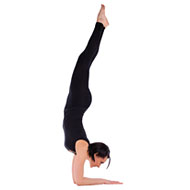
The feathered Peacock Pose or Pincha Mayurasana is the advanced variation of the Peacock Pose. This pose requires a lot of practice, strength and flexibility. Steps for this pose are illustrated below.- First, start with Downward Facing Dog (Adho Mukha Svanasana), near a wall.
- Place the forearms and the palms on the floor. The forearms should be parallel to each other and the fingertips at the base of the wall.
- The shoulder blades should be firm against the back and pulled towards the tailbone.
- Hug the forearms inward and rotate the upper arms outward. Spread the palms and place inner wrists firm on the floor.
- Bend the knee and bring the left foot in, close to the wall. Extend the right leg towards the wall and lift the left foot off of the floor, pushing the heel to straighten the leg.
- Exhale and jump up and down several times, each time trying to push off the floor slightly higher.
- At first, jumping up and down may be all you can manage, but regular practice of the Downward Facing Dog Pose or the Plank Pose will help you to achieve the required position.
- In the feathered Peacock Pose the head should be off the ground. Place the head in between the shoulder blades and keep your look fixed into the middle of the room.
- Stay in this pose for 10 to 15 seconds and slowly take it up to one minute. Do not land on the shoulders while coming down.
- Exhale and bring one foot down, keeping the shoulder blades upwards and wide.
- Repeat the same for another foot.
- Keep alternating the legs for the upward lift.
Preparatory Poses :
- Four Limbed Staff Pose (Chaturanga Dandasana)
- Seated Foot Behind the Head Pose (Eka Pada Sirasana)
Follow up poses :
- Downward Facing Dog (Adho Mukha Svanasana)
- One-handed Arm Balance (Eka Hasta Bhujanasana)
- Shoulder Pressing Pose (Bhujapidasana)
- Child Pose (Balasana)
- Foot Behind the Head Pose (Eka Pada Sirasana)
- Four Limbed Staff Pose (Chaturanga Dandasana)
Peacock Pose is one of those yoga poses which may seem difficult to perform in the beginning; however, practice and patience is the key. In the course of time, the body will find the balance and the fluidity required to perform the pose.
Peacock Pose