- Sun Salutation
- Headstand
- Inverted Triangle Pose
- Hand to Foot Pose
- Lion Pose
- Head to One Knee Pose
- Head to Knees Pose
- Camel Pose
- Sage Marichi Twist Pose
- Half Lord of the Fish Pose
- Inverted Leg Stretch Pose
- Shoulder Stand
- Plough Pose
- Inclined Plane
- Boat Pose
- Fish Pose
- Wheel Pose
- Bridge Pose
- Downward Facing Dog Pose
- Cobra Pose
- Bow Pose
- Locust Pose
- Eagle Pose
- Peacock Pose
- Crow Pose
- Corpse Pose
- Yoga Balance Asanas
- Yoga Asanas For Spine
- Yoga Asanas in Chair
- Basic Yoga Asanas For Stomach
- Yoga Asanas For The Neck
- Yoga Asanas For Depressed
- Yoga Asanas For Beginners
- One Legged King Pigeon Pose - Eka Pada Rajakapotasana
- Reclining Bound Angle Pose - Supta Baddha Konasana
- Eight Angle Pose - Astavakrasana
- Hand Clenching
- Side Crane Pose - Parsva Bakasana
- Ankle Rotation
- Circle pose - Mandalasana
- Dolphin Plank Pose
- Half Frog Pose - Ardha Bhekasana
- Four-Limbed Staff Pose - Chaturanga Dandasana
- Extended Puppy Pose - Uttana Shishosana
- Supported Headstand - Salamba Sirsasana
- Pendant Pose - Lolasana
- Shoulder-Pressing Pose - Bhujapidasana
- Ankle Bending
- Wrist Bending
- Standing Half Forward Bend
- Side-Reclining Leg Lift
- Standing Yoga Seal
- Shiva Twist
- Upward Salute
- Intense Side Stretch Pose
- Wild Thing
- Great Hand Posture
- Upward Bow
- Warrior Seal
- Spread Leg Forward Fold
- Legs-Up-the-Wall Pose
- King Pigeon Pose
- Arm Pressing Posture
- Upward-Facing Dog
- Crocodile Pose
- Feathered Peacock Pose
- Reclining Angle Pose
- Reclining Hero Pose
- Half Headstand Pose
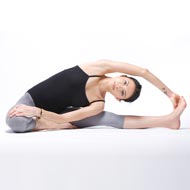
Sequencing Yoga Asanas
Correct sequencing of postures is crucial to a beneficial yoga session. This however can be quite challenging and the variety of poses can leave any beginner confused.
The sequence that you follow is quite important, as some poses are best followed by others, while others may need to follow a particular pose. This is crucial because yoga relies heavily on flowing movements, with the practitioner moving gracefully from one pose to the other.
Related Articles
Related Blogs
Related Topics
Yoga Questions
Continued...
Choosing your sequence poorly may not only disrupt this flow, but can also result in injuries as certain poses can not be attempted unless preceded by a specific pose.
Since you're working on serving your physical - and to some extent mental - needs, you modify the postures (asanas) in different ways. This depends upon individual constitutional requirements, structural issues and time of day, season, so on and so forth.
Modifications and variations are the key to a successful and profitable Yoga session. There isn't just one way to do this, though.
On the whole, however, middle-of-the-road, balanced stretching of most important muscle groups are preparation for bigger, more difficult, muscle stretches and contraction.
Moreover, an ordinary forward bend must, necessarily, come before another type of movement. For instance, lateral or backward bends or twists should follow. Likewise, when going from a deep twist to a backbend, ideally, you should do a forward bend at the start. You could then proceed in one direction.
However, when making a changeover to a different direction, you first have to first neutralize that muscle.
In the Viniyoga style, repetitions of poses are said to be more user-friendly. They are also found to be more effective in neuro-muscular re-education as well as re-patterning. This is essential for altering and modifying the structure. Once you are accustomed to a particular asana, your classic session would consist of entering into a posture, retaining it for a couple breaths, exiting, repeating the pose, hold it for 2 - 3 more breaths, exit again, repeat once more, remain there for 4 - 5 breaths, and exit. A lot of folks have to do lots of work in many repetitions prior to coming to realize the depth of what a motionless pose can offer.
The Yoga instructor's role is to help participant internally get the grasp of what is out of balance, and set a methodology. Through this they should be able to realize their goal. This could either be to take the bones back into symmetry or restore aligned balance to the muscles.
Sequencing Yoga Asanas