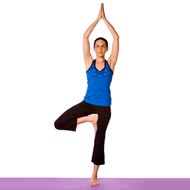
Tree Pose
Tree pose or vrkasana is a standing balancing pose which stretches your entire body. This pose makes your legs, ankles and feet stronger besides making hips and knees more flexible.
When performing this pose, imagine your body stretching down through the supporting leg and up through your arms and shoulder through your bent leg. Sink your weight down through the supporting foot, which you can imagine as the root of the tree, to keep you steadfast.


You can also gaze at a fixed point and concentrate on your breath to maintain steadiness. You can place your hands or press your shoulder blades and buttocks against the wall to remain steady. Closing your eyes in this pose will be challenging both to remain steady as well as focus your mind.
How it is to be done - standing.
Suitable for - Everybody.
Steps - Actual procedure for that asana.
- Begin in mountain pose
- Shift the weight on the left foot while your right leg is bent
- Rest the sole of the right foot against the inside of the left leg as high as possible but away from knee. The toes of this foot should be pointed downwards
- Join your palms together at the chest as in prayer pose
- Press the sole of the right foot against the interior of the left leg and keep the bent right leg relaxed
- The sole of the left foot should be pressed into the floor
- Inhale when raising the arms over the head, with palms together and stretched out through the fingertips
- The crown of the head should be towards the ceiling and gaze at the fixed point in front of you. Imagine you are stretching in upward, downward and outward all at once
- Remain in this pose for 15 to 30 seconds and then come back to mountain pose
- Repeat steps from 2 to 9 with the other leg
Benefits to body parts - Stretches the entire body. Strengthens legs, ankles and feet. Makes the hips and knees more flexible.